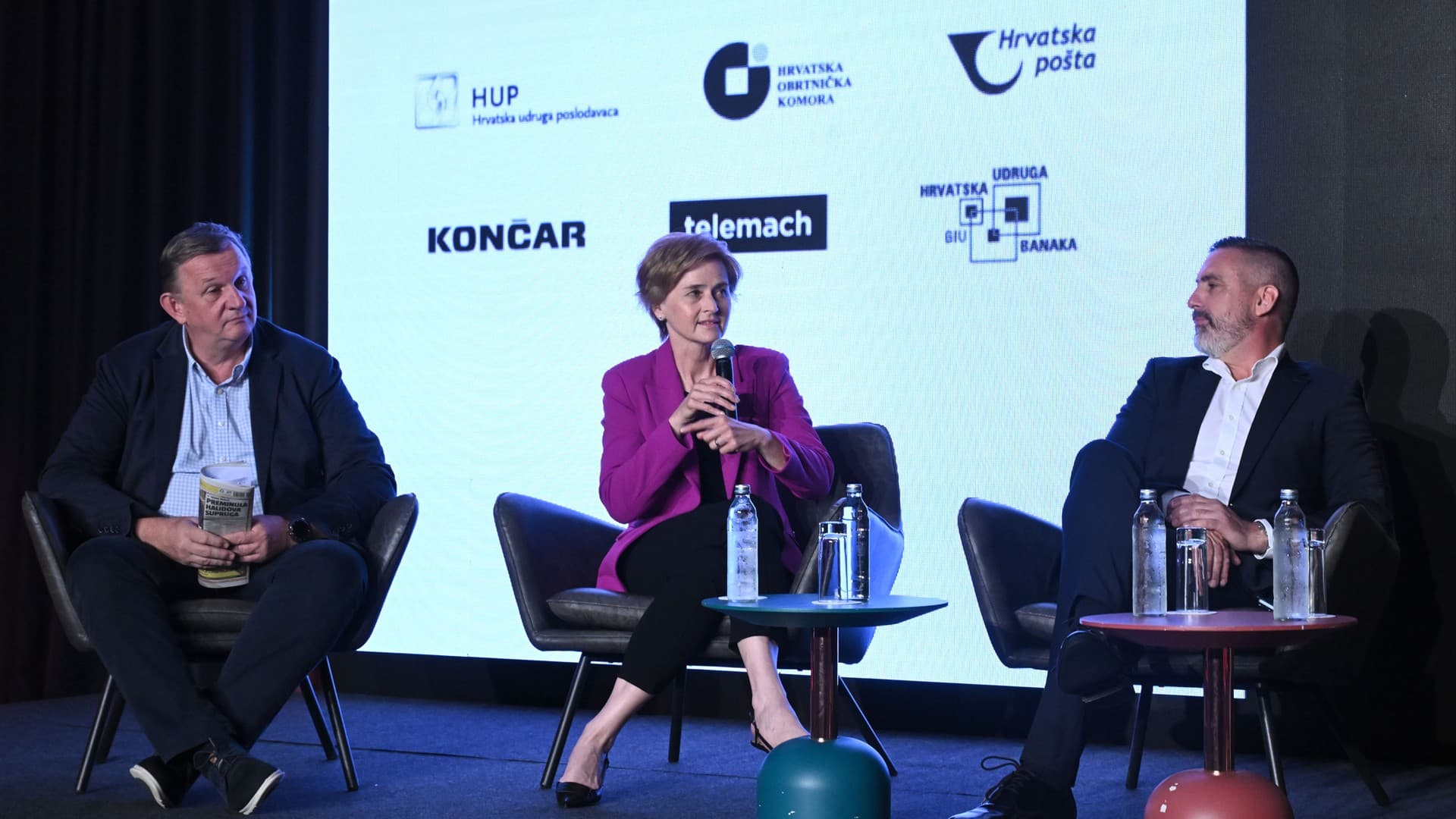
CNB Deputy Governor participated in the conference Kvaka24 "New Rules of the Game: A World of Change and Opportunity".
The conference brought together representatives from the business, financial and public sectors, who discussed the trends shaping the business environment, the impact of global movements on the Croatian economy, the energy situation, new sources of financing, reshoring opportunities, the digitalisation of business and the development of cashless payments. Deputy Governor took part in the panel "The Impact of Global Trends on the Croatian Economy".
In reference to CNB scenarios, she pointed out that the Croatian economy maintains a relatively high growth rate even in less favourable circumstances. The resilience is not only based on tourism, but also on domestic demand, investments, the use of EU funds, macroeconomic stability, a stable financial system and improved credit rating. According to current CNB estimates, the economy is still closer to the baseline scenario, and Croatia today faces global shocks from better macroeconomic positions than in previous periods.
Commenting on the possibility of a weaker tourist season, she said that tourism plays an important role in the Croatian economy, but that a single weaker result would not be a disaster. Such an outcome would, however, be an important signal for further reflection on prices, the quality of tourism products and the long-term positioning of Croatia as a tourist destination. As Croatia now competes in the "top league" in tourism, with destinations such as Italy and France, the price increase must be accompanied by an adequate quality of service, amenities and clear value for money.
Speaking of interest rates, Deputy Governor Švaljek emphasised that the CNB does not forecast their future movements. Decisions on monetary policy in the euro area are taken by the ECB Governing Council, on the basis of incoming data, new macroeconomic projections and an assessment of the inflation outlook. In a context of heightened geopolitical uncertainty and potential energy shocks, it is particularly important that decisions remain gradual and based on incoming data and regularly updated projections.
Commenting on the announced anti-inflation measures, Švaljek stated that fiscal measures are welcome if they alleviate pressures on citizens and businesses, but they must not create large fiscal imbalances or worsen the fiscal position beyond the Maastricht criteria framework. She welcomed the announcement of curbing government spending and limiting the growth of prices for services under state control, as such prices significantly contribute to service price inflation.