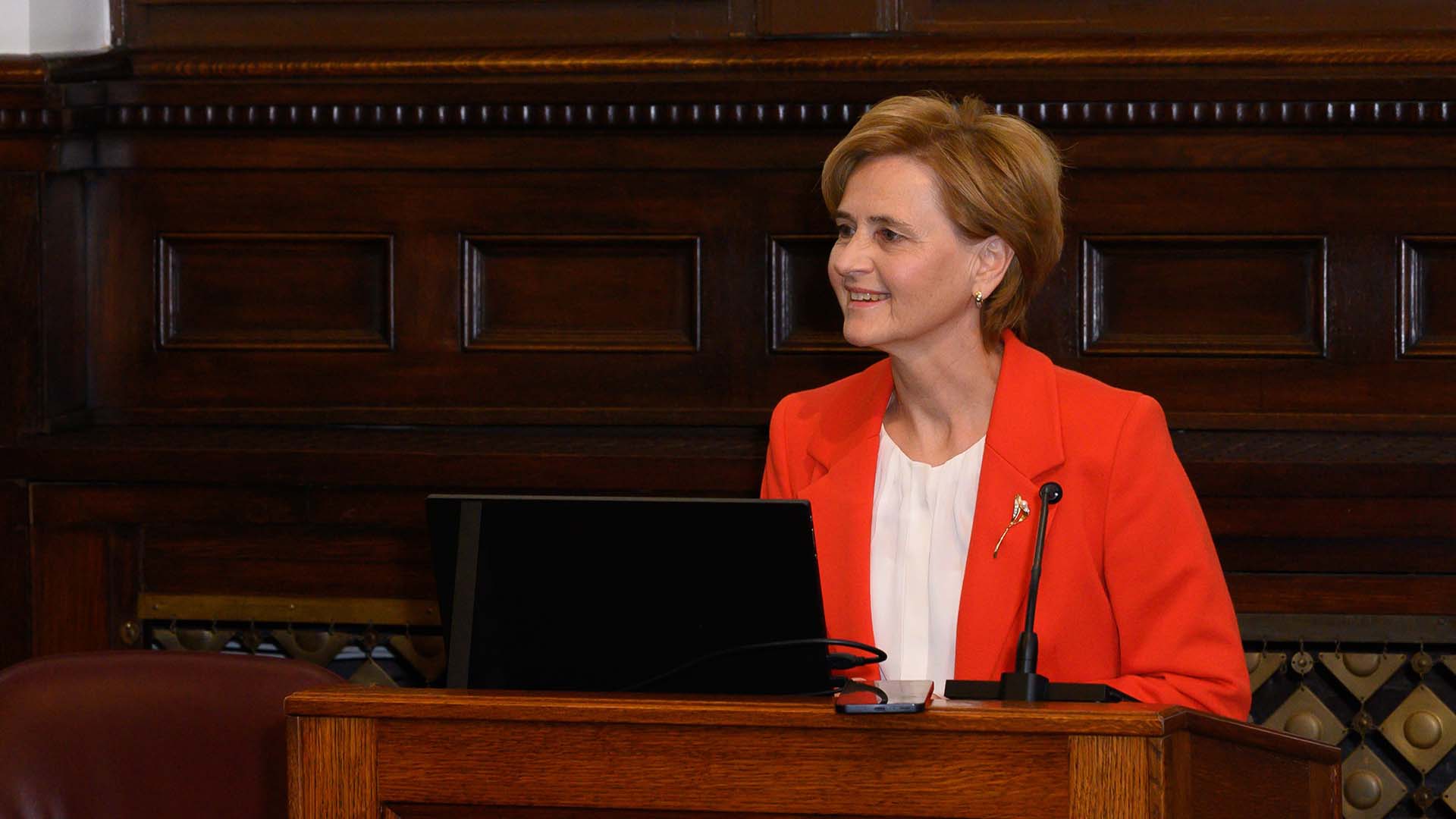
"Financial literacy is not only a matter of knowing basic financial concepts, but also the ability to use this knowledge to make informed financial decisions, avoid excessive risks and create reserves for old age and unforeseen circumstances", said Sandra Švaljek, Deputy Governor of the Croatian National Bank, in an opening speech at a round table organised by the Croatian Chamber of Economy to mark the World Savings Day.
Švaljek pointed out that the overall financial literacy of Croatian citizens is above the EU average, but with significant differences across individual components of financial literacy.
"In terms of financial knowledge, Croatia is below the EU average, while in terms of financial behaviour Croatia is at the top", said the Deputy Governor in the speech entitled "Linked by Invisible Treads of Financial Literacy", recalling that in the 2023 Flash Eurobarometer Survey of the European Commission, only half of the respondents in Croatia correctly answered at least three out of five questions on financial knowledge. She also warned that financial knowledge is not an end in itself, but is linked to specific financial outcomes, for example, individuals’ assessment of whether they could weather an unexpected income loss or whether they would have enough funds for retirement.
"For central banks, financial literacy is important because it also affects their performance in achieving the objectives – price stability and financial stability", said Švaljek. A higher level of financial literacy makes monetary policy transmission more effective and increases the resilience of households to financial shocks.
Referring to the financial decisions of Croatian households, she noted that real estate traditionally accounts for a large share of their total assets, while deposits predominate in financial assets, although their share has been gradually decreasing.
Commenting on household borrowing, the Deputy Governor warned that, despite a slight slowdown, household loans continued to grow at a two-digit rate. She also noted that banks had again started to offer loans with variable interest rates, which bear the risk of higher monthly loan repayments should interest rates increase.
"For example, let us look at a loan with a remaining principal of EUR 100 thousand and a repayment term of 15 years. An increase in the interest rate from 3 to 3.84 percent would raise the monthly annuity from EUR 691 to EUR 732 or EUR 41 per month", stated Švaljek during the presentation.
Referring to CNB measures, she argued that restrictions on consumer lending criteria introduced on 1 July 2025 had already led to a reduction in risk indicators for new loans, with the share of loans with a high repayment burden falling from around one third to 12 percent in housing loans. She also added that, with the stricter restrictions that entered into force on 1 October 2026, the CNB has reduced the permitted share of exceptions from the prescribed borrowing limits.
In conclusion, the Deputy Governor mentioned a series of activities undertaken by the CNB to improve the financial literacy of Croatian citizens, including an exhibition on the occasion of the World Savings Day, recently displayed in Zrinjevac Park in Zagreb.