
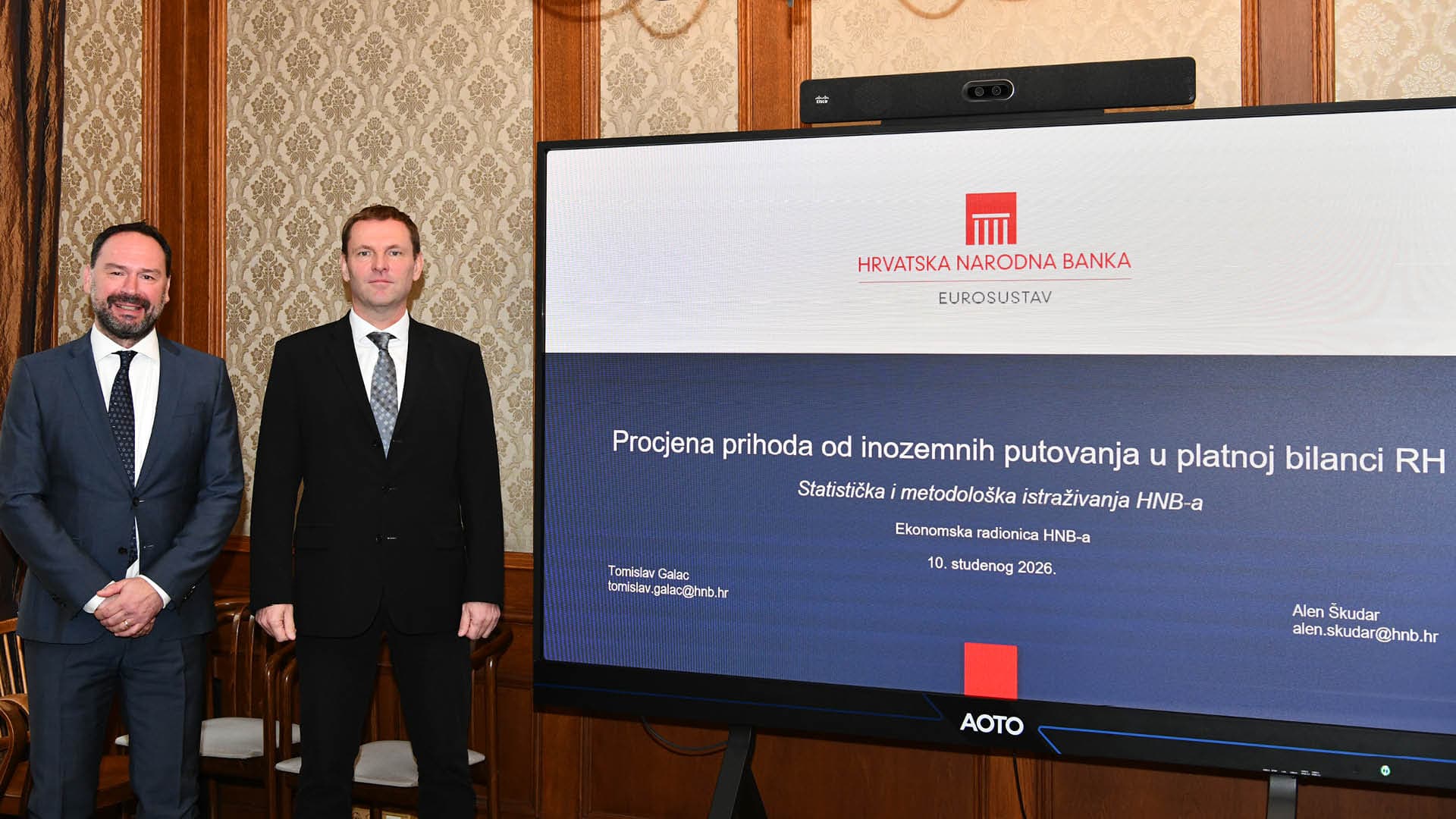
Alen Škudar and Tomislav Galac
At the 83rd CNB Economic Workshop held on 10 November, Tomislav Galac, Executive Director of the Statistics Area, and Alen Škudar, Director of the External Statistics Department, presented the paper entitled "Estimating the travel income position in the balance of payments of the Republic of Croatia", which illustrates the methodology for compiling the credit side of the travel item in the balance of payments statistics for the Republic of Croatia.
Given the great macroeconomic importance of travel services exports for Croatia, the paper explains the conceptual coverage of travel credit under international balance of payments standards.
"This is the first paper since the CNB Working Paper published in 2000 with a systematic focus on travel credit in the Croatian balance of payments. Often referred to as ‘foreign tourists' income’ among the general public, the concept represents a figure that is equally interesting to economic journalists, researchers and economic policy makers. Therefore, the reason for writing and publishing this paper was to bring the approach to statistical estimation of foreign tourists’ income closer to the general and professional public. With this in mind, the paper explains in detail the methods of estimating this income in other EU member states, describes the evolution of the Croatian National Bank’s estimation approach from the early 1990s to the present, and provides guidance for further methodological improvement," Škudar said.
Particular attention is given to the methodological break introduced during the COVID-19 pandemic, when traditional data sources based on border crossings and traveller surveys became inadequate, and to the resilience of the new methodology, introduced in the early COVID period, after Croatia’s accession to the euro area and the Schengen area. .
The paper explains the conceptual coverage of travel credit under international balance of payments standards.

"The paper concludes that the current methodology for estimating travel credit, which is based on a simple combination of data on payment card transactions by non-residents, fiscalised consumption data and supplementary administrative information, has significant advantages over the examined alternatives used in other EU member states. At the same time, it relies on a large number of assumptions, some of which could already be explicitly treated in the estimate of travel income, by adjusting the formula for its calculation. As for other assumptions, additional information will be needed to test the estimate sensitivity to their possible breaches", Galac noted.