
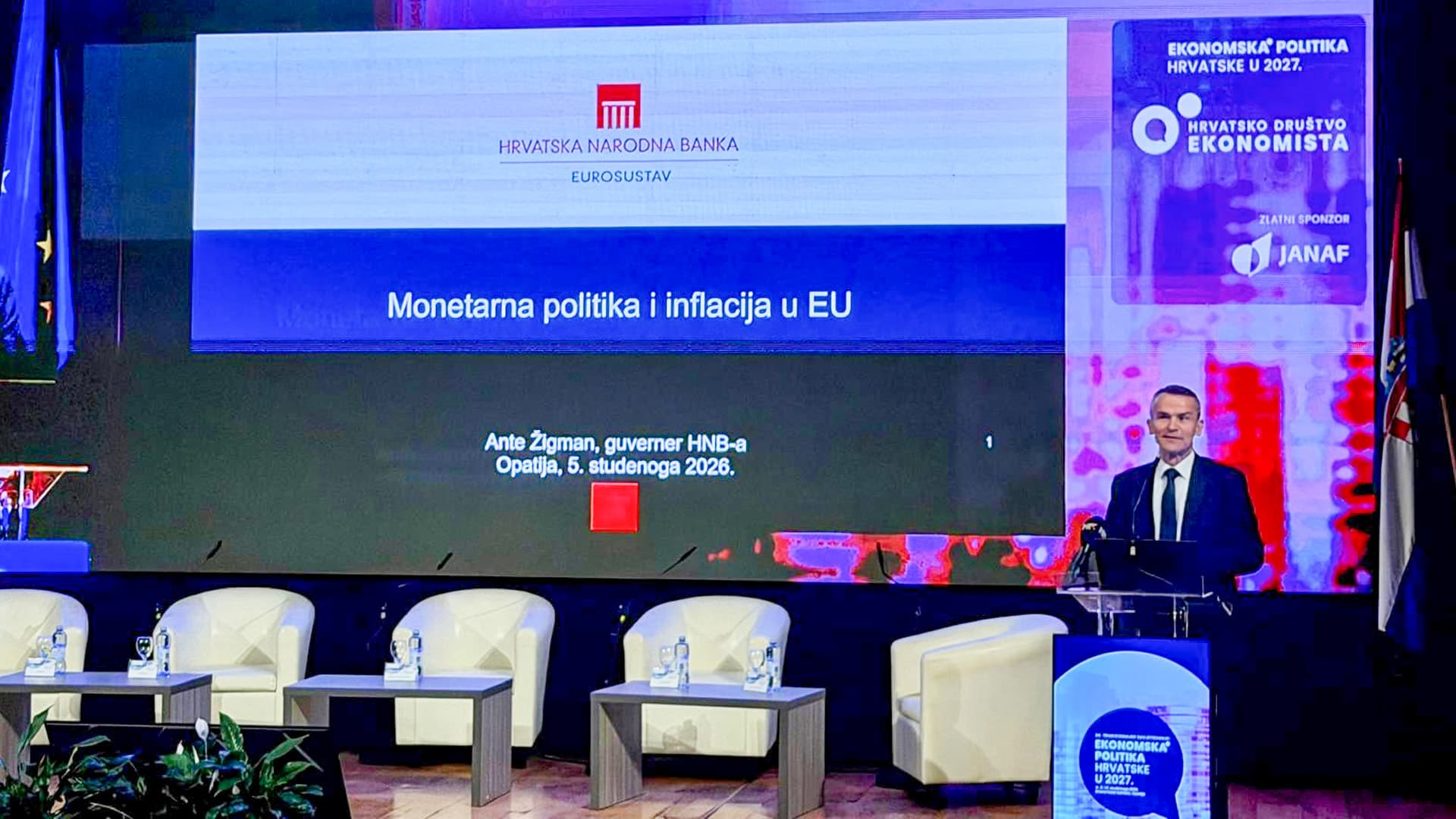
"While economic policies cannot prevent increasingly frequent external disruptions, which have become the main drivers of inflation, we can foster a stable environment and sustainable productivity-based growth without undue pressures on consumer inflation", noted CNB Governor Ante Žigman in his introductory address "Monetary Policy and Inflation in the European Union" at the 34th Traditional Conference of the Croatian Economic Association held in Opatija today.
On this occasion, the Governor recalled that for a number of years the global economy has been exposed to external shocks: from the pandemic and the ensuing disruptions in supply chains, the energy crisis following the Russian invasion of Ukraine and, since spring this year, renewed energy supply disruptions following the outbreak of the US-Iran conflict.
"The impacts of this situation are global, and are also felt in Croatia. This is particularly true for Croatian citizens and their daily lives. We can be satisfied that, for the time being, there is no major spillover of external disturbances into the prices of other consumer goods and services. Inflation has been increasing ‘directly’ due to the impact of high energy prices, and ‘indirectly’ due to the spillover of higher prices of energy products into production costs, while secondary effects, through a wage-price spiral, driven by higher inflationary expectations, are currently absent. The European Central Bank, i.e. the Governing Council of which I am a member, will continue to pursue a monetary policy focused on stabilising inflation at a 2% target over the medium term. For this purpose, the ECB will use key interest rates, its main tool for combating inflation", said Žigman.
At the same time, he stressed that Croatia can hardly or in no way influence external shocks and efforts are needed to limit indirect and secondary effects. "The proper response to this situation is the continued containment of domestic demand. Otherwise, fervent demand will make it easier for businesses to pass costs on to consumers, pushing inflation up. In such circumstances, after the pandemic and amid the war in Ukraine, domestic inflation has reached a higher level and proved to be much more persistent than in the rest of the euro area. Robust demand has made it easier for market participants to transfer higher costs to consumers, i.e. to end prices," said the CNB Governor, adding that the risks of rising inflation are even more pronounced in countries where rising energy and food prices have a stronger impact on the perception of overall inflation. "This is also the case in Croatia, because, among other things, food accounts for a large share of the consumer basket. A too-high perceived inflation can trigger a series of undesirable mechanisms that make actual inflation more persistent. Therefore, it is essential to actively engage in mitigating the bias in perceived inflation, above all through education, as well as strengthening confidence in institutions", concluded the CNB Governor.