
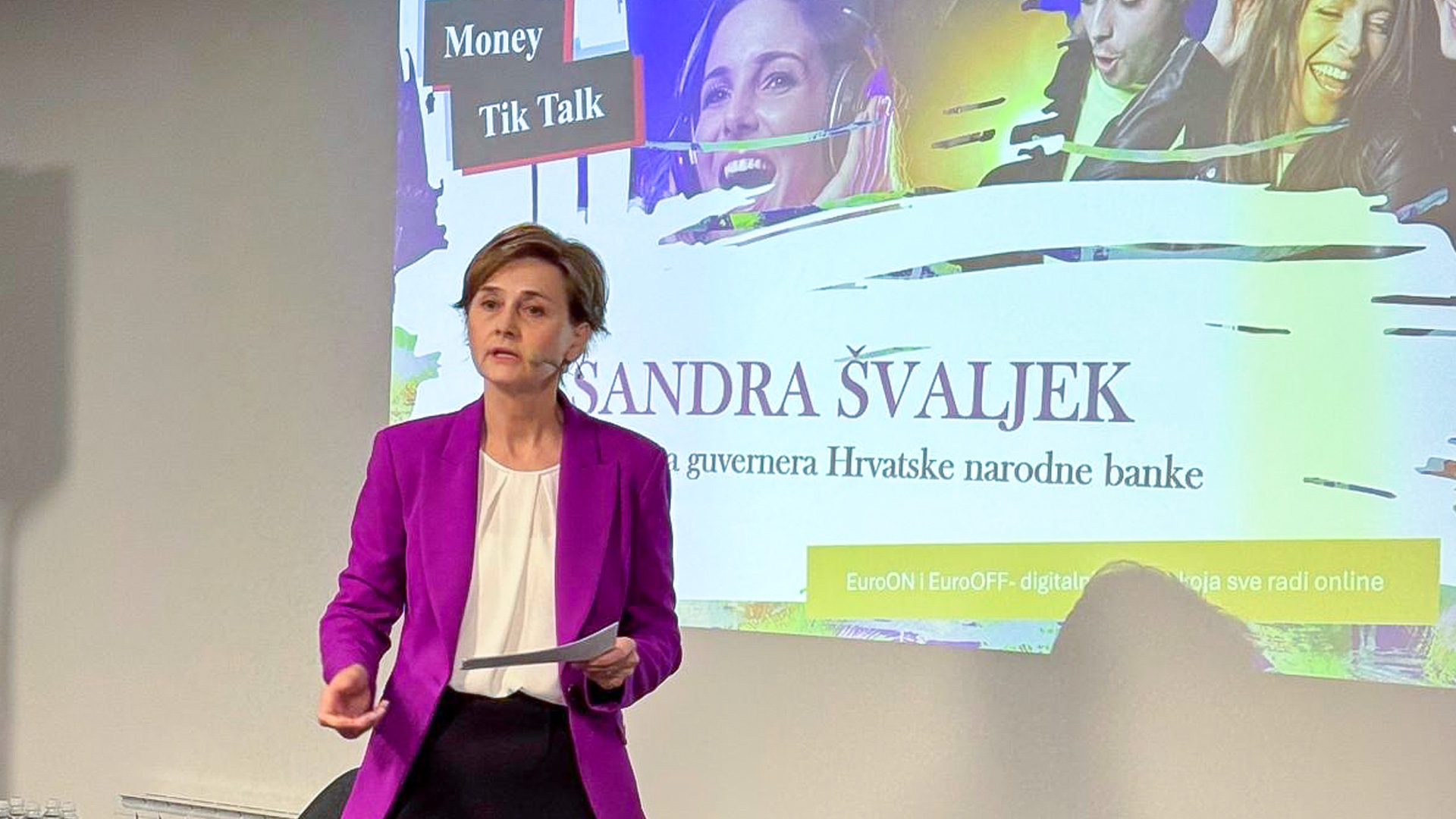
“Central bankers are paid to take care of the long-term risks that nobody else wants to see. This usually implies a daily focus on maintaining price and financial system stability. In recent times, money itself has become a focus of concern. In a rapidly changing world, we are wondering how to continue to supply the economy and individuals with an easily accessible, modern and universally acceptable means of payment, which will be both a stable measure of value and a reliable means of saving", said Sandra Švaljek, CNB Deputy Governor today, in her presentation "EuroON and EuroOFF: Digital euro for a generation that lives online" at the “Money Tik Talk” conference at the Zagreb School of Economics and Management.
She maintained that the evolution of payments has suppressed traditional forms of central bank money – banknotes and coins – and created the need for their digital equivalents. “The way we pay has changed significantly over the last 50 years. In the 1970s, almost all payments were made in cash, while today’s standard are contactless payments via cards and mobile devices. Although we use money every day, we see it less often in physical form, and the development of digital payments will definitely not come to an end. The digitalisation of payments began in 1872 with the use of telegraphs, while its modern evolution is linked to the first ATM in 1967, the emergence of online banking in the 1990s, followed by electronic payment platforms, digital wallets and biometric identification. The pandemic has further accelerated the shift to online and mobile payments. This impressive development has made payments faster and easier, but it has also brought new challenges – cash is becoming less important, while card and mobile applications are becoming more important, the need for online payments increases, and crypto-assets and stablecoins that can be used for payment purposes are emerging as payment instruments”, said the Deputy Governor. She stressed that the share of cash payments in the euro area decreased from almost 80% to just over half between 2019 and 2024, while the share of online payments rose from 7% to 21%. At present, one in three transactions in Croatia is made online.
She pointed out that each form of payment has its advantages and disadvantages – cash offers anonymity in payments and makes us more aware of the real scale of spending but it cannot be used for online purchases; digital payments are fast and easy, but they create costs for merchants and increase reliance on global card schemes, whereas acceptance of crypto-assets as a means of payment is still very limited.
"This is why central banks are developing digital solutions such as the digital euro, which is intended as a means of payment that combines the best of both worlds – the world of cash and the world of digital payment instruments, and eliminates the need to use those payment instruments that rely on crypto-assets, which are not money", said the CNB Deputy Governor.
The digital euro will provide security and reliability inherent to public money – cash – and the convenience of a digital means of payment. "In fact, in terms of convenience, the digital euro should outperform existing payment solutions, as it will be used for points-of-sale payments within a country and for cross-border payments within the euro area, as well as online and offline, and peer-to-peer payments."
"Though not as anonymous as cash, the digital euro will provide a higher level of privacy than most existing digital solutions. While it would not be programmable, it would allow for conditional payments. Finally, it is quite certain that most payments will be digital in the future. Cash will retain its role of a security alternative, while the digital euro will be one of the new options in an increasingly competitive digital payments space", Sandra Švaljek concluded.